Wilmington
- County formed 1729
- County seat Wilmington
- Parent district Craven
Photos & maps
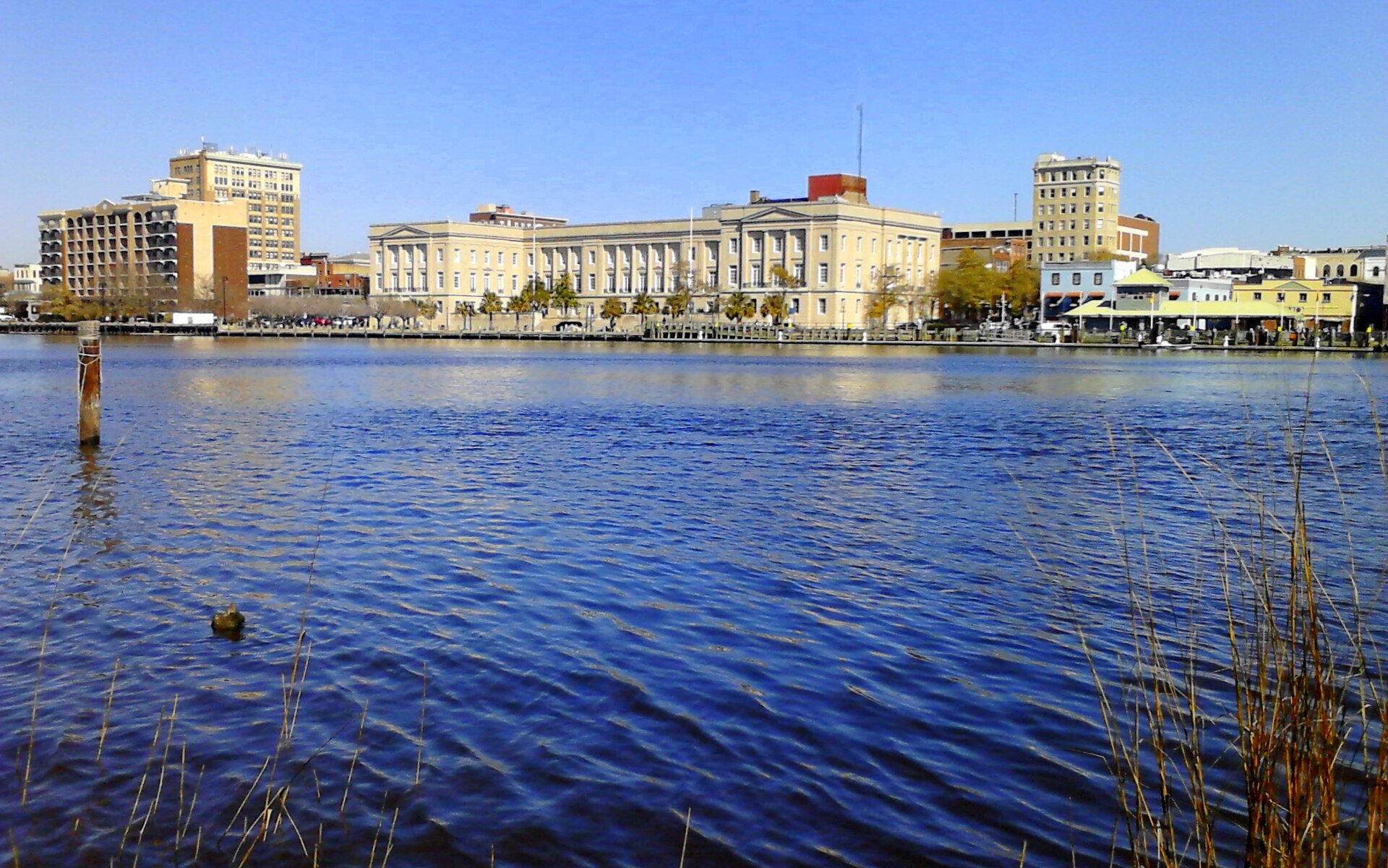
Begin with the place names that came before Wilmington
Newton or New Town on an old paper may lead to Wilmington, not another settlement. Wilmington is the county seat of New Hanover County on the Cape Fear River. The Gazetteer records a succession of early names: New Carthage about 1733, a brief use of New Liverpool, then New Town or Newton at the 1739-40 charter, and finally Wilmington. The town was named for Spencer Compton, Earl of Wilmington, a patron of Governor Gabriel Johnston. Incorporation followed in 1760.[1] Keep those earlier labels in your search terms. A deed, shipping paper or newspaper notice written under Newton or New Town is not a different settlement. It is the same river port under an older municipal name. When a passenger list or warehouse receipt uses Newton, keep that spelling in your log even if a later abstract says Wilmington.
Port and legislature dates are context, not family evidence
The Gazetteer describes Wilmington as a port for oceangoing vessels about thirty miles from the Atlantic Ocean and notes that the legislature met there in several years of the 1740s through 1764.[1] Those facts help explain why a household might appear in commercial or political records connected with the town. They do not prove that a particular ancestor owned a vessel, worked the docks or sat in the assembly. For a suspected waterfront occupation, establish the person’s named role and dates first. In a port community, many sailors and merchants share names. Match a vessel, employer, street or neighboring witness as well as the name before combining identities.
Read county-seat business carefully
A Wilmington address on a court or deed paper may mark where the record was filed, not where the family lived every day. Compare the property description and neighboring owners with the municipal label. Use the New Hanover County hub to choose the right series for the event year. The Gazetteer also notes the 1898 coup and racial violence as a local historical event.[1] Treat that as a documented civic crisis to research through contemporary newspapers and official records, not as a ready-made explanation for every family departure or property change in that year. Legislative-session years likewise explain why strangers appear briefly without proving permanent settlement.
The geographical source confirms location, the early name sequence, charter and incorporation milestones, legislative meeting years and the port setting. It does not certify surviving passenger lists, complete church registers or digitized newspaper coverage for every decade. Ask which collection could answer the question. The city’s age is no guarantee that the record survives.
Sources
Accessed November 9, 2026 EST. Authored secondary sources, not original family records. Research suggestions do not assert that a collection survives.
- William S. Powell and Michael Hill, eds., The North Carolina Gazetteer (2010), via NC Gazetteer transcription fetched November 9, 2026 EST. https://ncgazetteer.org/7bx42nnz4zm8c5dttgd3c.html
- NCpedia Gazetteer discovery URL for the same entry (live NCpedia HTML re-fetch returned Cloudflare 403 on November 9, 2026 EST; facts taken from the NC Gazetteer transcription above). https://www.ncpedia.org/gazetteer?combine=Wilmington
History & context
Wilmington sits within the documentary landscape of New Hanover County, formed in 1729 from the broader Craven jurisdiction.
As the seat of government, Wilmington concentrated clerks, lawyers, newspapers, hotels, and churches—making it a high-yield search term even for rural families who only visited for court, market, or marriage.
Coastal plain communities frequently connect to river trade, ports, agriculture, and free Black/plantation documentary streams. Cross-check neighboring counties when families followed rivers and rail lines.
For statewide chronology that creates records, see the NC genealogist timeline and counties & formation guide.
Churches & faith communities
Church membership is often the best substitute for missing civil vitals. Search for congregations that used Wilmington in their name or minutes, then widen to rural chapels within a few miles.
- Baptist and Methodist congregations are common statewide in the 19th–20th centuries.
- Track colonial Albemarle churches, coastal congregations, and historically African American churches—especially near ports and river towns.
- Membership lists, baptisms, marriages, and burials may use the community name even when the county clerk does not.
Guide: Church & meeting records.
Cemeteries & burials
Search cemeteries and churchyards under both the community name and the wider New Hanover County label. Family plots and unmarked burials are common.
- Use Find a Grave and published surveys; verify transcriptions against stones or originals when possible.
- City cemeteries near seats often hold rural families who “came to town” for burial plots.
Guide: Cemeteries & burial research · Find a Grave search for Wilmington
Newspapers
Newspapers are place-name gold: they index communities more loosely than deed books.
- County-seat papers often covered the whole county—search for rural neighborhoods and “items from Wilmington.”
- Look for marriages, obituaries, land sales, church news, and “personal mention” columns naming visitors and migrants.
- Combine local weeklies with larger regional papers (Raleigh, Charlotte, Greensboro, Asheville, Wilmington, etc.).
Guides: Newspapers · DigitalNC · Chronicling America
Research strategy
- Place the event in the right year and jurisdiction (county formed 1729); earlier events may sit in Craven.
- Work census clusters around Wilmington, then land/probate at the county seat (Wilmington).
- Use churches, cemeteries, and newspapers that name the community when civil vitals are thin.
- Widen to neighboring counties when deeds, marriages, or burials cross the line.