Ashe County Genealogy
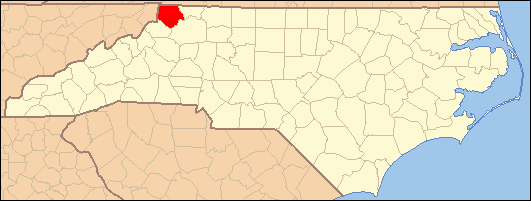
- Formed 1799
- Parent county / earlier Wilkes
- County seat Jefferson
- Neighbors Alleghany, Wilkes, Watauga
Photos & maps
What’s new
- New River highland settlement; Jefferson seat.
- Formation 1799 from Wilkes — for pre-formation events, use the parent jurisdiction’s paper (not later Anson-only catalogs).
- Seat: Jefferson · Neighbors: Alleghany, Wilkes, Watauga.
- Methods: Start here · Formation · Master guide.
Wilkes is the earlier courthouse to consider for an Ashe family. Ashe County was formed from Wilkes County in 1799 and named for Samuel Ashe, North Carolina’s governor from 1795 to 1798. Its county seat, Jefferson, was founded in 1803. If your family lived in the area before 1799, begin the courthouse search in Wilkes rather than expecting an Ashe record for an event that predates the county. [1]
The county occupies North Carolina’s northwestern corner, adjoining Virginia and Tennessee. NCpedia describes nineteenth-century farming communities along the New River and nearby valleys and names West Jefferson, Lansing, Todd and Glendale Springs among its communities. Keep those places distinct in a timeline. A relative remembered as living “in Jefferson” may need further identification before you can place the household accurately. [1]
Establish a location before extending the family line
Begin with the newest document that securely identifies the person and work backward. Copy the residence, household members and any named relatives. When a deed supplies a creek, road or adjoining owner, preserve that language. Do not replace a useful old place-name with the single word “Ashe.”
For a family near a state line, treat Virginia or Tennessee as a specific lead, not a general explanation for every gap. Look for a marriage place, birthplace, named relative or land reference that supports crossing the line. A same-name entry in a neighboring state is a candidate, not a completed connection. Compare several details before moving it into the family timeline.
Ashe’s 1799 formation gives you a clear starting point for an earlier Wilkes search. It does not mean every surviving Ashe series begins in 1799, or that every earlier reference will be found under Wilkes in a name index. Read the description of the actual collection and consider the date of the transaction as well as the date it was recorded. [1, 2]
Put a land description beside an estate
If the question is where a household lived, a deed and an estate can answer different parts of it. Search for the document behind the index, then extract the parties, dates, witnesses, acreage and boundary description. An estate may identify heirs or divide a tract whose earlier deed names only one owner. Conversely, a later sale may help explain what happened to land described in an estate.
Do not turn every associate into a relative. A purchaser, administrator, bondsman or witness has a defined role in the record. Record that role first. If the person later proves to be kin, cite the evidence for the relationship separately. This is particularly useful when several households share a surname along the same river or road.
The State Archives’ County Records Guide lists Ashe and Wilkes and arranges holdings by original records and microfilm, then by series. Land, courts, estates, marriage, tax and wills are among its categories. Consult the current entries to identify a relevant series and date span. The guide explains that holdings change, so an old list is not a guarantee of present access or complete coverage. [2]
Let local work suggest questions, not supply answers
Ashe’s history includes the copper mine at Ore Knob, iron production, farming, dairying and later manufacturing. NCpedia also describes the growing role of tourism around Jefferson, West Jefferson and the Blue Ridge Parkway. These are useful settings for an ancestor’s documented occupation, but none proves where a particular person worked. [1]
If family tradition mentions Ore Knob, begin by dating the tradition and identifying the person it concerns. Look for an independent residence or occupation reference. If a photograph shows a farm, distinguish the location of the picture from ownership of the land. A dated caption, deed or other contemporaneous document can move a story from possible to well supported.
The frescoes associated with artist Ben Long in Episcopal churches near West Jefferson and Glendale Springs are another example of place-specific history described by NCpedia. They can help identify a location mentioned in a later family account, but they are not a substitute for evidence about earlier church membership or burial. [1]
A regional archive may hold the surrounding story
The Western Regional Archives in Asheville collects material relating to western North Carolina. Its holdings are primarily private collections, with some microfilmed county records. Its finding aids are a sensible place to investigate a named organization, family collection or regional subject once you have a focused question. Do not assume that all Ashe courthouse records are held there. [3]
Before a visit or request, assemble names, dates, communities and references already found. Ask about the particular series or collection rather than requesting a complete surname history. Save unsuccessful searches with their limits. A failed index search is not evidence of a courthouse fire, and a general account of record loss does not tell you which series survives. Describe the missing evidence as precisely as the documents you already have.
Sources
Accessed November 9, 2026 EST. No unsupported courthouse-loss claim or individual family relationship is included.
- NCpedia, “Ashe County,” Encyclopedia of North Carolina. Formation, Jefferson, communities, geography and economic/cultural context. https://www.ncpedia.org/geography/ashe
- State Archives of North Carolina, “County Records Guide.” Arrangement and county entries, with changing holdings. https://archives.ncdcr.gov/researchers/collections/government-records/county-records-guide
- State Archives of North Carolina, “Western Regional Archives.” Regional collecting scope, location and finding aids. https://archives.ncdcr.gov/researchers/western-regional-archives
In-depth topics
Towns & communities
History notes
Ashe County (formed 1799 from Wilkes; seat Jefferson) is a distinctive research problem: New River highland settlement; Jefferson seat. Genealogists who treat every NC county the same will miss how virginia border marriages and burials shapes the paper trail here—and how parent wilkes for early grants changes which record class to open first.
Pin the decade before the courthouse. Record the jurisdiction as cited in the original deed, estate, or church book—then map it to modern hubs. Neighbor FAN clubs frequently spill into Alleghany, Wilkes, Watauga.
This county rewards a fixed order: census clusters with neighbors → land and probate in the correct years → church and cemetery substitutes for pre-vital generations → newspapers and directories around Jefferson for 19th–20th century moves. Use the record matrix on this hub as a planning tool, not a catalog.
Session order: write person + year + place as written → formation/parent check → census FAN club → land/probate → church/cemetery → newspapers/directories when town-era → neighbors listed above. Free path: Start here · formation guide · Master NC research guide. Statewide substitutes: State Archives of North Carolina · DigitalNC · NCGenWeb — Ashe.
The 1799 act and what came before
Ashe was formed in 1799 from Wilkes. The act, quoted in Corbitt's Formation of the North Carolina Counties, took "all that part of the county of Wilkes, lying west of the extreme height of the Apalachian mountains" and erected it into a separate county named for Samuel Ashe, governor from 1795 to 1798. Jefferson was laid out in 1803 and the public buildings put up there. The county's own history page traces the land back through Anson, Rowan (1753), Surry (1771) and Wilkes (1777), with a stretch inside the State of Franklin in the 1780s. Later subtractions matter too: Alleghany was formed from Ashe in 1859, and Watauga took Ashe land in 1849.
A note on surviving records
The State Archives catalog entry for Ashe describes the county's records by series but does not carry the kind of fire or loss note it gives for Watauga or Wilkes. Check the series list itself before assuming a run of deeds or minutes is complete.
Ashe offices and collections
- Ashe County Register of Deeds, 150 Government Circle, Suite 2300, Jefferson.
- Clerk of Superior Court in Jefferson for local estate and court files.
- Ashe County Public Library, founded in 1932 by the Ashe County Women's Club. In 1962 it joined the Wilkes and Watauga libraries to form the Appalachian Regional Library.
- Western Regional Archives in Asheville, part of the State Archives, for private papers and microfilmed county records from the mountain counties.
Settlers along the New River
The county history page records Peter Jefferson's 1749 survey party running the North Carolina and Virginia line and a 1752 visit by Moravian bishop Augustus Spangenberg, who was looking for 100,000 acres to settle. NCpedia describes the county as lightly populated through the nineteenth century, with small farming settlements along the New River and its valleys, and notes the copper mine at Ore Knob, briefly the largest copper producer in the country.
Working an Ashe family line
- For events before 1799, start in Wilkes. Between 1771 and 1777 the land was in Surry, and from 1753 to 1771 in Rowan.
- Ashe borders both Virginia and Tennessee, so a family that seems to vanish may be sitting across either line.
- If your family lived on the Alleghany side, switch to Alleghany records from 1859, and to Watauga from 1849 for the southwest corner.
- The State Archives' Cohabitation Records page lists Ashe among counties where no 1866 cohabitation records have been found, so look for freed families in census, church and deed records instead.
Record availability matrix
| Record type | Coverage | Years (approx.) | Notes |
|---|---|---|---|
| Federal census | good | 1799–1950 | Federal schedules for NC; place each household in the correct county for that decade. Before 1799, people will not be labeled Ashe—use Wilkes. Parent-jurisdiction notes apply only to pre-formation events—not to post-formation federal census rows. Township and city-ward labels change; re-pin every decade. |
| Birth records | sparse | 1913– | Statewide NC birth registration is late (roughly 1913–1915 for civil strength). Use delayed births, church registers, Bibles, and census for earlier Ashe generations—not parent-county “civil vitals.” |
| Marriage records | partial | 1799– | County marriage records improve in the 19th–20th centuries after formation (1799); earlier events often appear in church books, bonds, newspapers, or Wilkes. Confirm event-year jurisdiction vs modern address. |
| Death records | partial | 1913– | Death certificates denser after statewide registration (~1913–1915+). Earlier Ashe deaths via obituaries, church burial, probate, and cemeteries. |
| Land & deeds | partial | 1799– | Record-loss / thin-series note: 1865 fire left fragmented series. Mountain metes + neighbor counties (Wilkes and daughters) are essential substitutes. Ashe deed/Register of Deeds series typically begin near formation (1799); pre-1799 land lives under Wilkes. Colonial grants/plats may predate the county at State Archives of North Carolina. Always verify book/page gaps; abstract witnesses and neighbors. |
| Probate & estates | partial | 1799– | Record-loss / thin-series note: 1865 fire left fragmented series. Mountain metes + neighbor counties (Wilkes and daughters) are essential substitutes. Wills, administrations, inventories, and equity are core after 1799; pre-formation estates under Wilkes. Abstract bondsmen, sales, and widows’ petitions for FAN clubs. Pair thin years with newspaper legal notices and Archives microfilm. |
| Church & parish | partial | varies | Church coverage varies by denomination and survival. Baptisms, membership, and burial registers often beat early civil vitals; check local societies and denominational archives. |
| Newspapers | varies | varies | Jefferson and local weeklies, plus larger regional papers for legal notices and obituaries. Verify actual title runs on DigitalNC and Chronicling America before citing continuous coverage. |
| Military | good | 1775– | Revolutionary through 20th-century service may generate pensions, CMSRs, militia notes, and wartime claims. Pair unit research with Ashe place context and neighboring counties when companies recruited across lines. |
| Cemeteries | partial | varies | Published surveys, Find a Grave, churchyards, and family plots. Unmarked burials are common—use obituaries, church books, and land descriptions. In thin/burned courthouse decades, cemeteries and funeral notices become higher priority. |
| Court records | sparse | 1799– | Record-loss / thin-series note: 1865 fire left fragmented series. Mountain metes + neighbor counties (Wilkes and daughters) are essential substitutes. Common pleas, sessions, and other court series often begin near formation (1799); equity may sit with or near probate. Pre-1799 under Wilkes. |
| Tax lists | partial | varies | Tax lists can substitute for missing census years and thin deed decades. Coverage is uneven by locality and year—check State Archives of North Carolina and published abstracts. Especially valuable where courthouse series burned or moved. |
Cemeteries & burial research
- Jefferson / county-seat churchyards
- Ashe County cemeteries (Find a Grave / surveys)
Societies & repositories
Vital records
North Carolina statewide vital registration expanded in the early 20th century. For many Ashe County families you will rely on marriage bonds, church registers, Bible records, newspapers, delayed births, and probate—not only a modern certificate.
Research starting points
Courthouse & contacts
The county seat is Jefferson. Confirm current Register of Deeds, Clerk of Superior Court, and library hours before visiting—offices move and digital portals change.
Public library: Ashe County Public Library
Record-loss / series note: 1865 fire left fragmented series. Mountain metes + neighbor counties (Wilkes and daughters) are essential substitutes.
Record series note: 1865 fire left fragmented series in a mountain parent for Alleghany and parts of Watauga.
If not found here, try…
- Formed 1799
- Parent / earlier jurisdiction Wilkes — check district-era records before this county existed (districts guide).
Neighboring counties (deeds, marriages, newspapers, and kin often cross the line):
What to do next
Local history & events
- DAR volunteers at Museum of Ashe County History | Community | ashepostandtimes.com - Ashe Post & Times
- Three selected for Museum of Ashe County History 2026 ‘Who’s Who’ Awards - Ashe Post & Times
- Whitetop Mountain Band set to perform at the Museum of Ashe County History this Saturday - Ashe Post & Times
- ‘A Night at the Museum’ program set to return to Museum of Ashe County History Sept. 19 - Ashe Post & Times
- Our Avery County: Avery Museum celebrates 50 years! - The Avery Journal-Times
- Wayne Henderson, Herb Key and Friends to perform at museum Oct. 23 - Ashe Post & Times
Sources & further reading
- NCpedia — Ashe County
- David Leroy Corbitt, The Formation of the North Carolina Counties, 1663–1943
- William S. Powell, The North Carolina Gazetteer
- State Archives of North Carolina
- DigitalNC — Ashe County
- Chronicling America (Library of Congress)
- FamilySearch Wiki · NCGenWeb