Madison County Genealogy
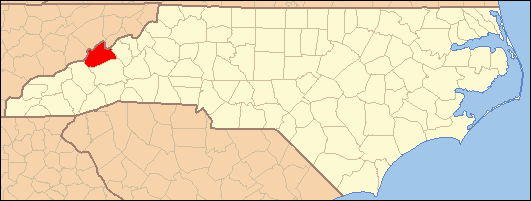
- Formed 1851
- Parent county / earlier Buncombe, Yancey
- County seat Marshall
- Neighbors Buncombe, Yancey, Haywood
Photos & maps
What’s new
- Marshall / Hot Springs mountain corridor.
- Formation 1851 from Buncombe, Yancey — for pre-formation events, use the parent jurisdiction’s paper (not later Anson-only catalogs).
- Seat: Marshall · Neighbors: Buncombe, Yancey, Haywood.
- Methods: Start here · Formation · Master guide.
The valley matters when choosing an earlier county for a Madison family. Madison County was formed in 1851 from parts of Buncombe and Yancey. Marshall, the seat, was incorporated in 1863. For an earlier family event, locate the homeplace closely enough to choose the relevant parent county rather than searching only under modern Madison. [1]
NCpedia lists Mars Hill, Hot Springs, Spring Creek, Walnut, Whiterock, Faust, Joe, Trust and Luck among local communities. Retain the smallest place name a source gives you. A household in one valley and a same-named household elsewhere in the county should not be merged merely because both later appear under Madison. [1]
Carry one family through the county change
Begin with a securely identified deed, household or estate. Copy watercourses, adjoining owners and prior conveyance references. Use that location to guide a Buncombe or Yancey search for the period before 1851. If the location remains uncertain, preserve the alternatives instead of choosing whichever parent produces a familiar surname first.
Keep the execution and recording dates of a deed separate. A later document can preserve an earlier transaction. A county-label change is not automatically a migration, but continuity still needs to be shown through land, family members or other recurring details.
The State Archives’ County Records Guide lists Madison, Buncombe and Yancey. It distinguishes original records from microfilm and groups holdings by series. Choose land, court, estates, tax, marriage or wills according to the question. Confirm the current holding and access route before traveling. [2]
The Tennessee line is a clue, not an answer
Madison borders Tennessee. A documented reference across that line deserves a separate county-and-date search, but a general border location does not establish that every missing marriage or family event occurred there. [1]
Carry a named person across the line using spouses, children, occupations, land and associates. A shared surname is insufficient. Keep the original jurisdiction in the citation rather than replacing it with a modern Madison location.
A church or cemetery lead should likewise retain its name and locality. Identify whether the source is a register, a later abstract, a survey or a modern memorial. Those materials can differ in date and purpose even when they concern the same person.
Civil War stories need source-by-source care
NCpedia identifies the Shelton Laurel Massacre of 1863, when men and boys suspected of Unionist sympathies were executed. A family claim connected with that event needs evidence naming the individual and explaining the relationship. Do not assign political allegiance or participation from county residence alone. [1]
Separate contemporary records from later histories and oral accounts. Preserve who supplied a statement and when. If accounts conflict, retain both until the difference can be explained. A dramatic county story should not fill an otherwise undocumented gap in an ancestor’s life.
For a military claim, identify a person, unit and source and compare the details with the known household. A matching name in a roster is only a candidate until identity is established.
Hot Springs and Mars Hill suggest different record paths
NCpedia describes Hot Springs as a nineteenth-century resort and notes its World War I connection with German prisoners. It dates Mars Hill College to 1856. These are distinct institutional histories. A personal connection to one requires its own evidence and collection search. [1]
If a letter, occupation or school reference identifies an institution, establish the exact period and role. A student, employee, visitor and nearby resident are different claims. Ask whether relevant records survive and whether they are accessible; historic status does not make every personal file public.
The county account also notes Cecil Sharp’s collection of regional ballads in 1916. A family tradition about a singer can be investigated through an identified recording or manuscript, but a broad account of local music does not prove a particular ancestor contributed. [1]
Freed families and the limits of one source
The State’s cohabitation guide lists Madison among counties for which its cited index found no cohabitation records. This cannot disprove a couple’s union or establish that all relevant evidence has vanished. [3]
Begin with an independently identified post-emancipation household and compare family members, ages and associates. Pursue earlier links through specific estate, court or land records when a traceable clue supports them. A shared surname does not establish an enslaver or parent.
Log the repository, county, series, years, result and page or image. Use those limits to ask about one valley, household and series next, instead of starting another general Madison surname search.
Sources
Accessed November 9, 2026 EST. Historical context and repository descriptions are distinguished from the research recommendations above. Catalog coverage is not a guarantee of surviving or online records.
- NCpedia, “Madison County.” Historical summary supporting the local dates, places and context cited above. https://www.ncpedia.org/geography/madison
- State Archives of North Carolina, County Records Guide. Explains original and microfilm holdings, series arrangement and changing holdings. https://archives.ncdcr.gov/researchers/collections/government-records/county-records-guide
- North Carolina Digital Collections, Cohabitation Records. Madison limitation. https://digital.ncdcr.gov/spotlights/cohabitation-recs
In-depth topics
Towns & communities
History notes
Madison County (formed 1851 from Buncombe, Yancey; seat Marshall) is a distinctive research problem: Marshall / Hot Springs mountain corridor. Genealogists who treat every NC county the same will miss how parent buncombe/yancey shapes the paper trail here—and how tennessee border movement changes which record class to open first.
Pin the decade before the courthouse. Record the jurisdiction as cited in the original deed, estate, or church book—then map it to modern hubs. Neighbor FAN clubs frequently spill into Buncombe, Yancey, Haywood.
This county rewards a fixed order: census clusters with neighbors → land and probate in the correct years → church and cemetery substitutes for pre-vital generations → newspapers and directories around Marshall for 19th–20th century moves. Use the record matrix on this hub as a planning tool, not a catalog.
Western land-cession and multi-state border context requires careful primary sources—see the Indigenous research guide when relevant, and log Tennessee/Georgia neighbors when surnames cluster west or south.
Session order: write person + year + place as written → formation/parent check → census FAN club → land/probate → church/cemetery → newspapers/directories when town-era → neighbors listed above. Free path: Start here · formation guide · Master NC research guide. Statewide substitutes: State Archives of North Carolina · DigitalNC · NCGenWeb — Madison.
Historical markers in Madison County
- P-71 Shelton Laurel Massacre
In January 1863 Confederate troops under Lt. Col. James A. Keith took thirteen men and boys from their homes around Shelton Laurel and shot them, after Unionist raids on Marshall. DNCR's essay notes the exact date is still debated, that one historian's case for January 18 rests on petitions the widows filed, and that six of the dead were Sheltons. Relatives placed new granite stones at the graves in 1968.
- P-102 Mary Sands 1872-1949
Mary Sands was born Mary Bullman in Madison's Laurel section on April 8, 1872, and married James Monroe Sands in 1892; they had ten children. DNCR's essay says that beginning on July 31, 1916, she sang 25 ballads over five days for the English collector Cecil Sharp, and that her mother, Rosannah Bullman, had first been married to Hugh Wallin, who died in the Civil War.
- P-66 Balladry
When Cecil Sharp came to Madison in 1916, his richest finds were at Hot Springs, Allanstand, Sodom Laurel and nearby. DNCR's essay says Jane Gentry, whose family lived at the Sunnybank boarding house in Hot Springs, gave him sixty-four songs, more than any other singer he met, and that her daughter, Maude Gentry Long, later made many recordings for the Library of Congress.
- P-24 Hot Springs
Hot Springs, known as Warm Springs until 1886, drew visitors to its mineral waters from the early 1800s. DNCR's essay says the springs passed in 1831 to James Patton of Asheville, who put up a 350-room hotel, and that in 1917 the federal government leased the grounds as an internment camp for German merchant sailors. About 2,700 were held there; eighteen died of typhoid and lie in Riverside Cemetery in Asheville.
- P-34 Mars Hill College
Mars Hill College began in 1856 as the French Broad Baptist Institute on land given by Edward Carter and took the Mars Hill name two years later. DNCR's essay records that when building money ran out, the contractor had Joe, an enslaved man belonging to trustee J. W. Anderson, held in the Asheville jail as collateral. The school closed in 1863, and from 1872 to 1878 its buildings housed a branch of the Oxford Masonic Orphanage.
- P-80 Bascom Lamar Lunsford
Bascom Lamar Lunsford (1882-1973) was born at Mars Hill, where his father then taught at the college. DNCR's essay says he settled in 1925 on South Turkey Creek, on land his wife had inherited, was N.C. House clerk from 1931 to 1934, and from 1928 ran the Asheville event later known as the Mountain Dance and Folk Festival. Columbia University had him record 350 songs from memory in 1935.
All 2 other markers in Madison County, by number
- P-27 Paint Rock
Record availability matrix
| Record type | Coverage | Years (approx.) | Notes |
|---|---|---|---|
| Federal census | good | 1851–1950 | Federal schedules for NC; place each household in the correct county for that decade. Before 1851, people will not be labeled Madison—use Buncombe, Yancey. Parent-jurisdiction notes apply only to pre-formation events—not to post-formation federal census rows. Township and city-ward labels change; re-pin every decade. |
| Birth records | sparse | 1913– | Statewide NC birth registration is late (roughly 1913–1915 for civil strength). Use delayed births, church registers, Bibles, and census for earlier Madison generations—not parent-county “civil vitals.” |
| Marriage records | partial | 1851– | County marriage records improve in the 19th–20th centuries after formation (1851); earlier events often appear in church books, bonds, newspapers, or Buncombe, Yancey. Confirm event-year jurisdiction vs modern address. |
| Death records | partial | 1913– | Death certificates denser after statewide registration (~1913–1915+). Earlier Madison deaths via obituaries, church burial, probate, and cemeteries. |
| Land & deeds | good | 1851– | Record-loss / thin-series note: Formed 1851 from Buncombe/Yancey. Mountain multi-parent; French Broad corridors spill into neighbors routinely. Madison deed/Register of Deeds series typically begin near formation (1851); pre-1851 land lives under Buncombe, Yancey. Colonial grants/plats may predate the county at State Archives of North Carolina. Always verify book/page gaps; abstract witnesses and neighbors. |
| Probate & estates | good | 1851– | Record-loss / thin-series note: Formed 1851 from Buncombe/Yancey. Mountain multi-parent; French Broad corridors spill into neighbors routinely. Wills, administrations, inventories, and equity are core after 1851; pre-formation estates under Buncombe, Yancey. Abstract bondsmen, sales, and widows’ petitions for FAN clubs. Pair thin years with newspaper legal notices and Archives microfilm. |
| Church & parish | partial | varies | Church coverage varies by denomination and survival. Baptisms, membership, and burial registers often beat early civil vitals; check local societies and denominational archives. |
| Newspapers | varies | varies | Marshall and local weeklies, plus larger regional papers for legal notices and obituaries. Verify actual title runs on DigitalNC and Chronicling America before citing continuous coverage. |
| Military | good | 1775– | Revolutionary through 20th-century service may generate pensions, CMSRs, militia notes, and wartime claims. Pair unit research with Madison place context and neighboring counties when companies recruited across lines. |
| Cemeteries | partial | varies | Published surveys, Find a Grave, churchyards, and family plots. Unmarked burials are common—use obituaries, church books, and land descriptions. |
| Court records | partial | 1851– | Record-loss / thin-series note: Formed 1851 from Buncombe/Yancey. Mountain multi-parent; French Broad corridors spill into neighbors routinely. Common pleas, sessions, and other court series often begin near formation (1851); equity may sit with or near probate. Pre-1851 under Buncombe, Yancey. |
| Tax lists | sparse | varies | Tax lists can substitute for missing census years and thin deed decades. Coverage is uneven by locality and year—check State Archives of North Carolina and published abstracts. |
Newspapers
Cemeteries & burial research
- Marshall / county-seat cemeteries
- Madison County cemeteries (Find a Grave / surveys)
Societies & repositories
Vital records
North Carolina statewide vital registration expanded in the early 20th century. For many Madison County families you will rely on marriage bonds, church registers, Bible records, newspapers, delayed births, and probate—not only a modern certificate.
Research starting points
Courthouse & contacts
The county seat is Marshall. Confirm current Register of Deeds, Clerk of Superior Court, and library hours before visiting—offices move and digital portals change.
Public library: Madison County Public Library
Record-loss / series note: Formed 1851 from Buncombe/Yancey. Mountain multi-parent; French Broad corridors spill into neighbors routinely.
If not found here, try…
- Formed 1851
- Parent / earlier jurisdiction Buncombe, Yancey — check district-era records before this county existed (districts guide).
Neighboring counties (deeds, marriages, newspapers, and kin often cross the line):
Local history & events
Sources & further reading
- NCpedia — Madison County
- David Leroy Corbitt, The Formation of the North Carolina Counties, 1663–1943
- William S. Powell, The North Carolina Gazetteer
- State Archives of North Carolina
- DigitalNC — Madison County
- Chronicling America (Library of Congress)
- FamilySearch Wiki · NCGenWeb