Wilkes County Genealogy
- Formed 1778
- Parent county / earlier Surry
- County seat Wilkesboro
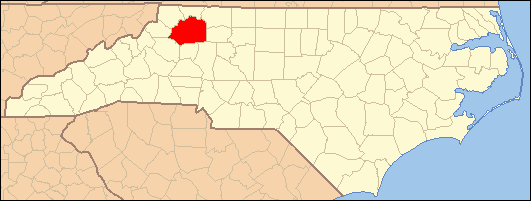
- Neighbors Surry, Yadkin, Iredell, Alexander, Caldwell, Watauga, Ashe, Alleghany
Photos & maps
What’s new
- western Piedmont/mountain-edge parent for Ashe and highland problems.
- Formation 1778 from Surry — for pre-formation events, use the parent jurisdiction’s paper (not later Anson-only catalogs).
- Seat: Wilkesboro · Neighbors: Surry, Ashe, Alleghany, Watauga, Caldwell, Alexander, Yadkin, Iredell.
- Methods: Start here · Master guide.
For an early Wilkes search, keep both formation dates in view. The act creating it was ratified December 24, 1777, but the division took effect February 15, 1778. The act took territory from Surry County and the District of Washington. For a family appearing near the changeover, keep the date of the event separate from the year printed in a county-history summary. The law also allowed Surry’s officers to collect money already owed when the division occurred. An entry in a parent county after the effective date need not mean the family moved. [3]
Wilkesboro is the county seat. The original act ordered the new county court to meet at John Brown’s house, with sessions on the first Mondays of March, June, September and December. It also kept Wilkes in the Salisbury Superior Court district. Those provisions give an early court search a more precise starting point than a modern courthouse address. [1, 3]
Start with what the Register of Deeds actually holds
The Wilkes Register of Deeds describes land records dating to 1778, birth and death records dating to 1913, and marriage licenses dating to 1882, with some earlier record-only marriage entries. Its page also distinguishes delayed births with earlier dates. These descriptions are more useful than assuming every record class began when Wilkes was created. [4]
For a nineteenth-century marriage, ask which format survives for the particular year: a license, a recorded entry, or another marriage-related series. A failure to find a license before 1882 is not evidence that no marriage occurred. Use the State Archives guide to identify additional marriage and court material, and search the parents’ jurisdictions when the event predates the county. [2, 4]
For land, begin with the Register’s official link to its online land-record service. Record the index entry and obtain the deed. Preserve the book and page, date executed, date recorded, names of both parties, witnesses and the description of the tract. The county’s statement about records dating to 1778 does not promise that every image or index is online. Check the relevant book rather than treating a modern search box as the complete collection. [4]
Put a mountain family on a map
NCpedia identifies the Yadkin River and W. Kerr Scott Reservoir among the county’s physical features. Its community list includes Roaring River, Ronda, Moravian Falls, Boomer, Ferguson, Millers Creek, Mulberry and Wilbar, as well as North Wilkesboro. Keep these place names beside the surname in your notes. A reference to Ferguson or a creek can be a better discriminator than an often-repeated given name. [1]
Build a small place table from the records you find: name as written, document date, watercourse or road, adjacent owners, and the county named in that document. Plot only what the evidence permits. Do not place an eighteenth-century tract on a current reservoir shoreline without examining an older map. If two families share a surname, compare their adjoining owners before joining their trees.
Follow the household, not just a famous surname
The county’s history includes the story later popularized as “Tom Dooley.” NCpedia identifies Tom Dula, Laura Foster and Ferguson in that context. A ballad or local tradition can suggest a topic, but it does not establish a relationship to an unrelated person bearing the same name. Search for your own family in household, land and estate evidence before connecting it to a well-known narrative. [1]
For an estate question, the State Archives guide separates estates from wills and lists courts, tax, land and other record groups. Search beyond a will index: ask about administrators’ accounts, guardianship material and proceedings involving land. A sale purchaser or bondsman is worth following, but label that connection as an association until another source identifies the relationship. [2]
Keep gaps specific
Use the current Archives guide to determine which Wilkes volumes or files cover the year needed. If a volume is missing, record its identity and ask about copies or related proceedings. A negative name search alone cannot establish that a record was destroyed. [2]
End a Wilkes research session with three separate results: what the original record says, what you infer from it, and what remains unresolved. Save the repository, collection, volume, page or image and search date. That makes a later search in Surry or Washington District material a deliberate next step rather than a second attempt at the same broad surname search.
Sources
Accessed November 9, 2026 (EST). Historical statements are cited in the text. Suggested searches are research recommendations, not claims of a particular family match or complete surviving coverage.
- NCpedia, “Wilkes County,” Encyclopedia of North Carolina (2006), including editorial additions where present. https://www.ncpedia.org/geography/wilkes . Authored historical overview, not an original family record.
- State Archives of North Carolina, County Records Guide. https://archives.ncdcr.gov/researchers/collections/government-records/county-records-guide . Repository guide explaining original and microfilm holdings, series arrangement and changing availability.
- J. D. Lewis, Carolana, transcription of Laws of North Carolina, 1777, chapter XXXII, State Records volume XXIV, pp. 142 to 144, ratified December 24, 1777. https://www.carolana.com/NC/Counties/1777_NC_Legislative_Act_to_Establish_Wilkes_County.html . Derivative transcription of the formation statute; sections II, III, VII and VIII support the transition advice.
- Wilkes County Register of Deeds, official office page. https://www.wilkescounty.net/268/Register-of-Deeds . Repository description supporting the stated land, vital and marriage coverage, delayed births and official land-search link.
In-depth topics
Towns & communities
History notes
Wilkes County (formed 1778 from Surry; seat Wilkesboro) is a research problem defined by western Piedmont/mountain-edge parent for Ashe and highland problems. Yadkin headwaters farm networks and later town density create dual systems. Parent Surry contexts matter for early mapping.
How Wilkes came to be
The General Assembly carved Wilkes out of Surry County and the District of Washington by an act of 1777 that took effect on February 15, 1778. That act sent the first court to the house of John Brown and named commissioners to choose a central site for a courthouse, prison and stocks; the second court met on June 1, 1778, "in the bent of the Yadkin," according to David Leroy Corbitt's The Formation of the North Carolina Counties. Wilkes soon became a parent itself. In 1799 the legislature made everything west of "the extreme height of the Apalachian mountains" into Ashe County, and in 1849 Watauga was assembled from parts of Ashe, Wilkes, Caldwell and Yancey. A family that never moved can therefore appear in Surry, Wilkes, Ashe or Watauga paper depending on the year.
What the fires took
The State Archives catalog entry for Wilkes (CR.104) says that "some losses of records are believed to have resulted from fires in the second courthouse (1830 - 1902)." What survives is still substantial: about 555 cubic feet of originals and 2,110 microfilm reels, with tax records running from 1778 to 1908 and election records from 1778 to 1970, plus series for estates, wills, land and court records.
Where to ask for Wilkes records now
- Wilkes County Register of Deeds, 500 Court House Drive, Suite 1000, Wilkesboro. The office page says its land records go back to the county's formation in 1778, births and deaths begin in 1913 (with some earlier delayed births), and marriage licenses start in 1882 with some earlier record-only entries. Land records have been searchable online at wilkesncrod.org since July 1, 2017.
- Clerk of Superior Court in Wilkesboro for estate and court files that remain local. Older wills, estates and court minutes are part of CR.104 at the State Archives in Raleigh.
- Wilkes Genealogical Society, which keeps its local and family history collection inside the Wilkes County Public Library in North Wilkesboro and publishes the Wilkes Genealogical Society Bulletin. The society notes that the Genealogy Room is not staffed on a regular basis, so call the library before a trip.
Who settled the upper Yadkin
NCpedia lists the Tutelo and Cherokee among the area's early inhabitants and German and Scotch-Irish families among the settlers who followed. The same entry dates Wilkesboro's incorporation to 1847 and names Ronda, Roaring River, North Wilkesboro, Moravian Falls, Boomer, Ferguson, Millers Creek, Mulberry, Wilbar and Austin as other Wilkes communities, which helps when a deed or obituary gives only a place name.
Wilkes-specific research tips
- Freed families: the State Archives' Cohabitation Records collection, which holds the 1866 registrations that legitimized marriages of formerly enslaved couples, lists Wilkes volume CR.104.606.1 as available. A second Wilkes item, CR.104.928.6, is flagged as needing further research.
- The Freedmen's Bureau kept an office at Wilkesboro. The National Archives guide to microfilm M1909 lists J. F. Allison there from September to December 1867 and agent James Carle from March to June 1868. The Wilkesboro letters sent (September 1867) and endorsements (October 1867 to June 1868) each have a name index.
- Before you search Ashe for a pre-1799 event or Watauga for one before 1849, read the Wilkes deeds and court minutes for the same family.
Record availability matrix
| Record type | Coverage | Years (approx.) | Notes |
|---|---|---|---|
| Federal census | good | 1790–1950 | Federal schedules after formation; pre-1778 is Surry. Re-pin mountain households carefully. |
| Birth records | sparse | 1913– | Late civil; church books critical earlier. |
| Marriage records | partial | 1778– | County series after formation; earlier Surry/church. |
| Death records | partial | 1913– | Certificates denser after statewide registration; churchyards earlier. |
| Land & deeds | good | 1778– | Record-loss / thin-series note: Formed 1778 from Surry: mountain metes, ridge families, and later boundary adjustments. Continuity varies—test neighbors and Surry parent context. Post-1778 deeds; pre-formation Surry. Mountain metes need careful abstracting; ridge families spill across lines. |
| Probate & estates | good | 1778– | Record-loss / thin-series note: Formed 1778 from Surry: mountain metes, ridge families, and later boundary adjustments. Continuity varies—test neighbors and Surry parent context. Estates + guardian bonds high value; search neighbors when thin. |
| Church & parish | partial | varies | Church coverage varies by denomination and survival. Baptisms, membership, and burial registers often beat early civil vitals; check local societies and denominational archives. |
| Newspapers | varies | varies | Wilkesboro/North Wilkesboro papers—confirm DigitalNC runs before citing continuity. |
| Military | good | 1775– | Revolutionary through 20th-century service may generate pensions, CMSRs, militia notes, and wartime claims. Pair unit research with Wilkes place context and neighboring counties when companies recruited across lines. |
| Cemeteries | partial | varies | Published surveys, Find a Grave, churchyards, and family plots. Unmarked burials are common—use obituaries, church books, and land descriptions. |
| Court records | partial | 1778– | Common pleas, sessions, and other court series often begin near formation (1778); equity may sit with or near probate. Pre-1778 under Surry. Known disruption: No major fire on standard lists; Surry parent (1778); mountain parent for many daughters. |
| Tax lists | sparse | varies | Tax lists can substitute for missing census years and thin deed decades. Coverage is uneven by locality and year—check State Archives of North Carolina and published abstracts. |
Newspapers
Cemeteries & burial research
- Wilkesboro / historic cemeteries
- Wilkes County cemeteries (Find a Grave / surveys)
Societies & repositories
Vital records
North Carolina statewide vital registration expanded in the early 20th century. For many Wilkes County families you will rely on marriage bonds, church registers, Bible records, newspapers, delayed births, and probate—not only a modern certificate.
Research starting points
Courthouse & contacts
The county seat is Wilkesboro. Confirm current Register of Deeds, Clerk of Superior Court, and library hours before visiting—offices move and digital portals change.
Public library: Wilkes County Public Library (Appalachian Regional Library)
Record-loss / series note: Formed 1778 from Surry: mountain metes, ridge families, and later boundary adjustments. Continuity varies—test neighbors and Surry parent context.
If not found here, try…
- Formed 1778
- Parent / earlier jurisdiction Surry — check district-era records before this county existed (districts guide).
Neighboring counties (deeds, marriages, newspapers, and kin often cross the line):
Local history & events
Sources & further reading
- NCpedia — Wilkes County
- David Leroy Corbitt, The Formation of the North Carolina Counties, 1663–1943
- William S. Powell, The North Carolina Gazetteer
- State Archives of North Carolina
- DigitalNC — Wilkes County
- Chronicling America (Library of Congress)
- FamilySearch Wiki · NCGenWeb